

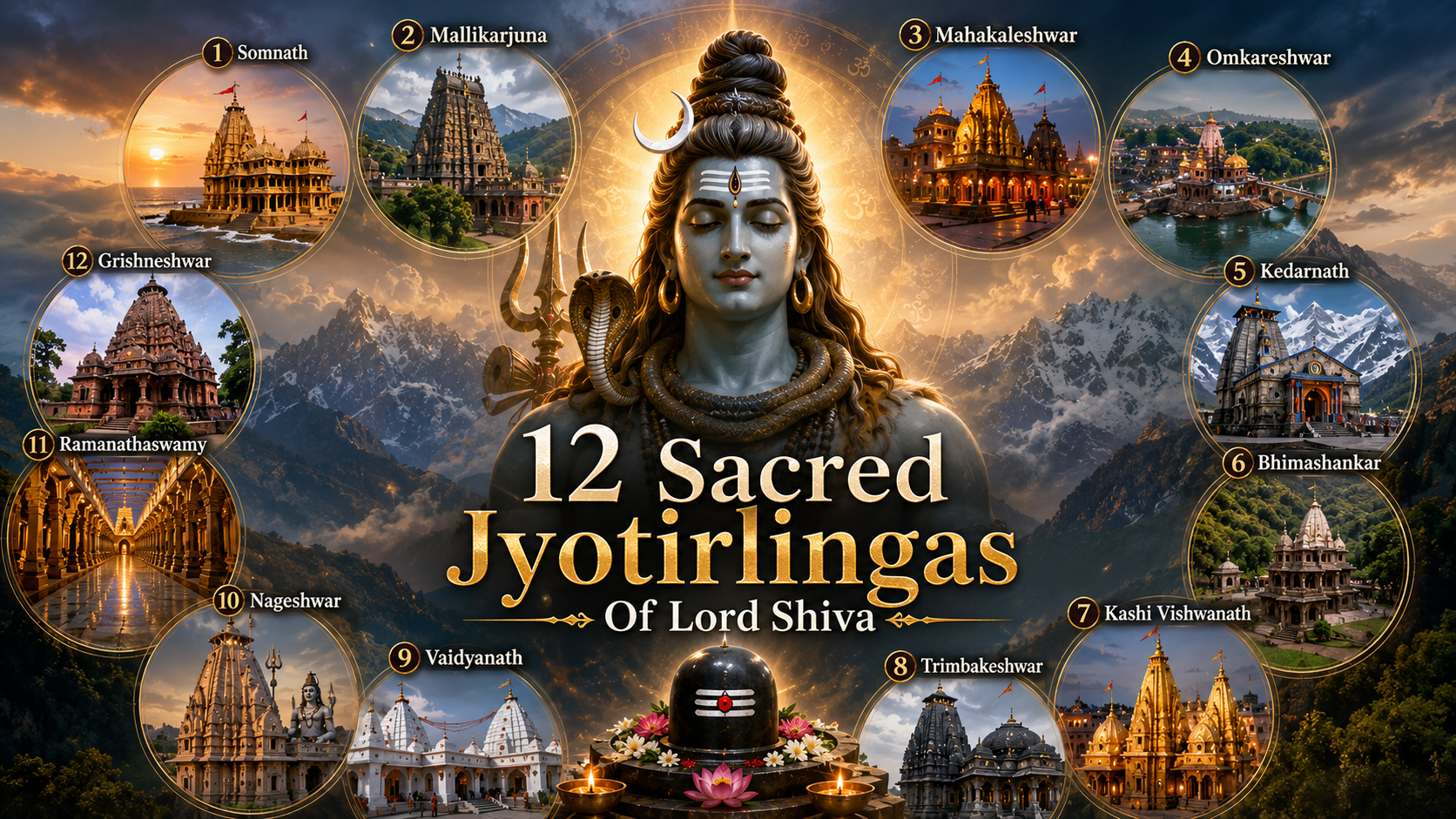
The 12 Jyotirlingas are among the most revered pilgrimage destinations in Hinduism. Dedicated to Lord Shiva, these sacred shrines are believed to be places where Shiva manifested as a divine pillar of light, known as a Jyoti. The word Jyotirlinga is derived from two Sanskrit words: Jyoti (light) and Linga (the symbolic representation of Shiva).
According to the Shiva Purana, Lord Brahma and Lord Vishnu once debated who was supreme. To settle the dispute, Lord Shiva appeared as an endless column of divine light. Unable to find its beginning or end, both deities acknowledged Shiva’s infinite nature. The twelve Jyotirlingas are believed to mark locations where this divine manifestation was experienced on Earth. For devotees, visiting the 12 Jyotirlingas is considered one of the most spiritually rewarding pilgrimages. Each temple carries unique legends, rituals, blessings, and historical significance while collectively representing the many facets of Lord Shiva’s divine presence.
Somnath Jyotirlinga (Gujarat)
Significance and History
Somnath, located on the western coast of Gujarat, is traditionally regarded as the first Jyotirlinga. According to legend, Chandra Dev (the Moon God) was cursed by Daksha Prajapati and began losing his brilliance. He worshipped Lord Shiva at this site and was eventually relieved of the curse.
The temple has endured repeated destruction and reconstruction over centuries, making it a powerful symbol of faith, resilience, and devotion.
Best Time to Visit
October to March offers pleasant weather for pilgrimage. Mahashivratri is one of the most auspicious times to visit.
Important Rituals
- Jalabhishek (offering water)
- Rudrabhishek
- Bilva Patra offering
- Evening Aarti
Spiritual Benefits
Devotees believe Somnath helps remove negativity, restore emotional balance, and strengthen faith during difficult times.
Mallikarjuna Jyotirlinga (Andhra Pradesh)
Significance and History
Situated on the sacred Srisailam hills, Mallikarjuna is unique because it is associated with both Lord Shiva and Goddess Parvati. The name combines “Mallika” (Parvati) and “Arjuna” (Shiva).
According to tradition, Shiva and Parvati came here to console their son Kartikeya after he withdrew into solitude following a family dispute.
Best Time to Visit
October to February and the holy month of Karthika are considered ideal.
Important Rituals
- Abhishekam with milk and honey
- Kumkum Archana
- Giripradakshina around the sacred hill
Spiritual Benefits
The temple is believed to bless devotees with family harmony, marital happiness, and spiritual growth
Mahakaleshwar Jyotirlinga (Madhya Pradesh)
Significance and History
Located in Ujjain, Mahakaleshwar is one of the most powerful Jyotirlingas. Lord Shiva is worshipped here as Mahakal, the Lord of Time and Death.
Ancient scriptures describe how Shiva manifested here to protect devotees from a destructive demon. The deity’s south-facing orientation makes this temple particularly unique among Jyotirlingas.
Best Time to Visit
October to March and the month of Shravan.
Important Rituals
- Bhasma Aarti (the temple’s most famous ritual)
- Rudrabhishek
- Mahamrityunjaya Jaap
- Panchamrit Abhishek
Spiritual Benefits
Devotees seek protection from fear, untimely death, and negative influences while cultivating courage and inner strength.
Omkareshwar Jyotirlinga (Madhya Pradesh)
Significance and History
Omkareshwar is located on an island in the Narmada River that resembles the sacred symbol “Om” when viewed from above.
The temple represents the cosmic vibration from which creation emerged. It is considered one of the most spiritually uplifting destinations for meditation and self-reflection.
Best Time to Visit
October to March.
Important Rituals
- Narmada Snan
- Omkar Parikrama
- Rudrabhishek
- Narmada Aarti
Spiritual Benefits
The shrine is associated with mental peace, concentration, and spiritual awakening.
Kedarnath Jyotirlinga (Uttarakhand)
Significance and History
Nestled in the Himalayan mountains at an altitude of over 11,000 feet, Kedarnath is among the most revered Shiva temples in India.
According to legend, the Pandavas sought forgiveness from Lord Shiva after the Kurukshetra war. Shiva initially avoided them by taking the form of a bull, but eventually blessed them at Kedarnath.
Best Time to Visit
May to June and September to October. The temple remains closed during winter due to heavy snowfall.
Important Rituals
- Morning Abhishek
- Ghee offering
- Kedarnath Parikrama
- Shiva Sahasranama recitation
Spiritual Benefits
Pilgrims believe that visiting Kedarnath purifies accumulated karma and inspires spiritual transformation.
Bhimashankar Jyotirlinga (Maharashtra)
Significance and History
Located amidst the Sahyadri hills, Bhimashankar is associated with Lord Shiva’s victory over the demon Bhima.
The temple is surrounded by forests and wildlife, making it a serene destination for prayer and contemplation.
Best Time to Visit
August to February.
Important Rituals
- Rudrabhishek
- Bilva Patra offering
- Shiva Mantra chanting
- Panchamrit Abhishek
Spiritual Benefits
The temple is believed to offer protection from negativity and strengthen spiritual discipline.
Kashi Vishwanath Jyotirlinga (Uttar Pradesh)
Significance and History
Kashi Vishwanath in Varanasi is perhaps the most famous Jyotirlinga. Varanasi is considered Shiva’s eternal city and one of the world’s oldest continuously inhabited cities.
Ancient scriptures state that Lord Shiva himself grants liberation to sincere devotees who attain spiritual realization in Kashi.
Best Time to Visit
October to March.
Important Rituals
- Ganga Snan before darshan
- Jalabhishek
- Rudrabhishek
- Mangala Aarti
Spiritual Benefits
The temple is strongly associated with moksha (liberation), wisdom, and spiritual enlightenment.
Trimbakeshwar Jyotirlinga (Maharashtra)
Significance and History
Situated near Nashik, Trimbakeshwar is unique because the Jyotirlinga symbolizes the divine trinity of Brahma, Vishnu, and Shiva.
The sacred Godavari River originates near this temple, adding to its spiritual importance.
Best Time to Visit
July to February.
Important Rituals
- Narayan Nagbali Puja
- Kaal Sarp Dosh Puja
- Rudrabhishek
- Godavari Snan
Spiritual Benefits
Devotees visit to seek ancestral blessings, remove karmic obstacles, and attain peace.
Vaidyanath Jyotirlinga (Jharkhand)
Significance and History
Vaidyanath, also known as Baidyanath Dham, is worshipped as Shiva the Divine Healer.
According to legend, Ravana performed intense penance here to receive Shiva’s blessings. The temple continues to attract millions of devotees seeking healing and divine grace.
Best Time to Visit
Shravan month and October to February.
Important Rituals
- Jalabhishek using holy water
- Rudrabhishek
- Bel Patra offering
- Continuous mantra chanting
Spiritual Benefits
The temple is believed to support physical healing, emotional recovery, and spiritual well-being.
Nageshwar Jyotirlinga (Gujarat)
Significance and History
Located near Dwarka, Nageshwar Jyotirlinga is associated with protection from fear, poison, and evil influences.
Lord Shiva is worshipped here as the protector of devotees from destructive forces and inner negativity.
Best Time to Visit
October to March.
Important Rituals
- Milk Abhishek
- Rudra Path
- Bilva Archana
- Shiva Sahasranama recitation
Spiritual Benefits
Devotees seek courage, protection, and mental stability through worship at Nageshwar.
Ramanathaswamy Jyotirlinga (Tamil Nadu)
Significance and History
Located in Rameshwaram, this Jyotirlinga is closely connected to Lord Rama. According to the Ramayana, Lord Rama worshipped Shiva here before crossing the ocean to Lanka.
The temple stands as a beautiful symbol of harmony between Shaivism and Vaishnavism.
Best Time to Visit
October to April.
Important Rituals
- Bathing in the 22 sacred wells
- Rudrabhishek
- Ganga Jal offering
- Temple corridor parikrama
Spiritual Benefits
The rituals here are believed to cleanse sins and prepare devotees for spiritual progress.
Grishneshwar Jyotirlinga (Maharashtra)
Significance and History
Located near the Ellora Caves, Grishneshwar is the final Jyotirlinga in the traditional sequence.
Its legend centers around Ghushma, a devoted woman whose unwavering faith moved Lord Shiva to appear and bless her.
Best Time to Visit
October to March.
Important Rituals
- Rudrabhishek
- Bilva Patra offering
- Om Namah Shivaya chanting
- Shiva Mantra Jaap
Spiritual Benefits
The temple inspires devotion, perseverance, forgiveness, and spiritual fulfillment.
Why Visit All 12 Jyotirlingas?
The 12 Jyotirlingas collectively represent different aspects of Lord Shiva’s divine energy. Somnath symbolizes renewal, Mallikarjuna family harmony, Mahakaleshwar protection from time and fear, Omkareshwar spiritual awakening, Kedarnath purification, Bhimashankar strength, Kashi Vishwanath liberation, Trimbakeshwar ancestral blessings, Vaidyanath healing, Nageshwar protection, Ramanathaswamy purification, and Grishneshwar devotion.
Undertaking the Jyotirlinga pilgrimage is considered a journey of self-discovery, faith, and spiritual transformation.
Conclusion
The 12 Jyotirlingas are far more than temples; they are living centers of devotion, history, culture, and spiritual energy. For centuries, devotees have traveled across mountains, rivers, forests, deserts, and coastlines to seek the blessings of Lord Shiva at these sacred sites.
Whether one seeks healing, protection, wisdom, peace, liberation, or a deeper connection with the divine, the Jyotirlingas continue to inspire millions of pilgrims every year. A journey through these twelve sacred shrines is not merely a tour of India’s spiritual heritage—it is a profound pilgrimage into the heart of devotion itself.
