

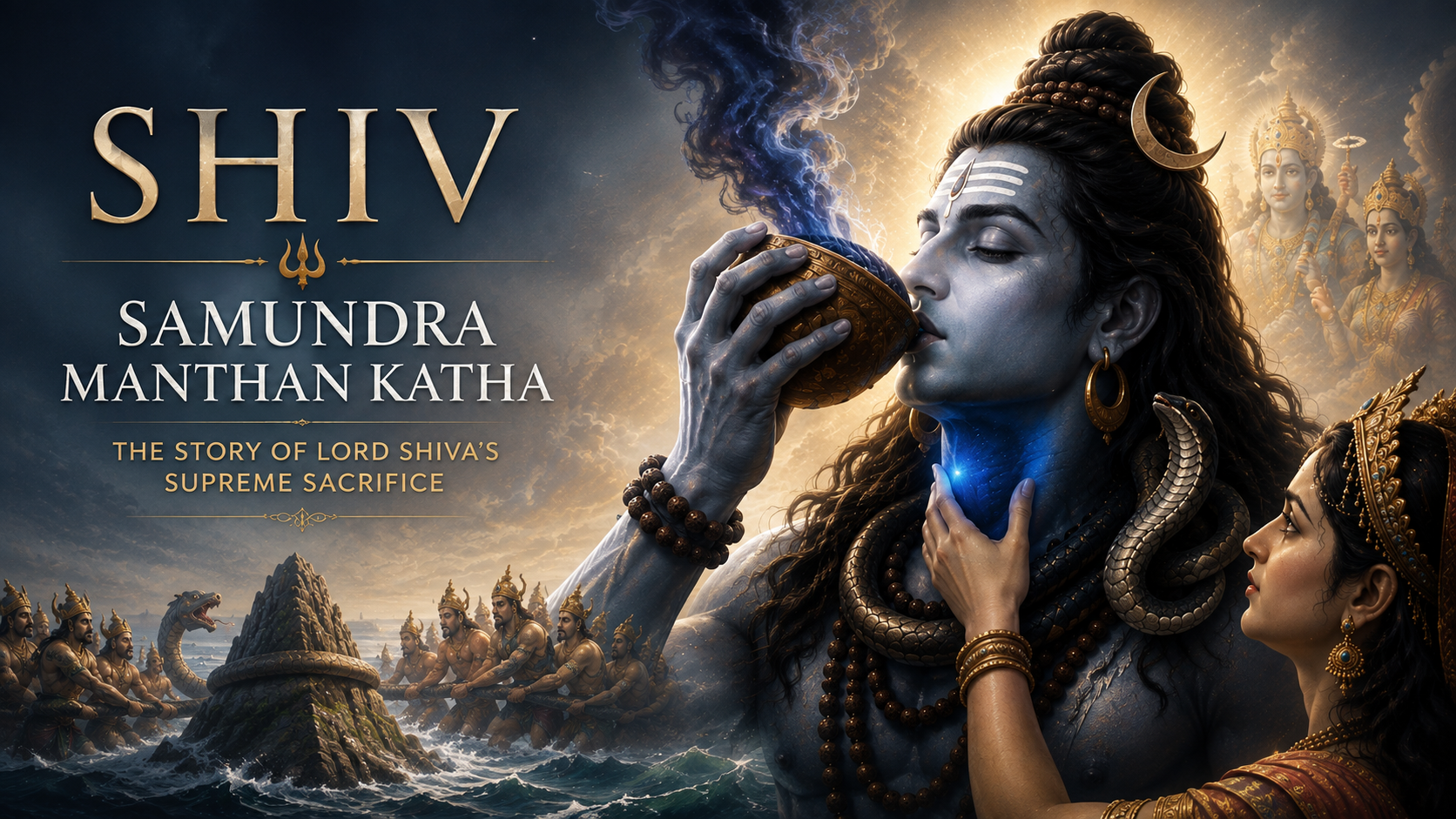
The Shiv Samundra Manthan Katha is one of the most inspiring and spiritually significant stories in Hinduism. It tells the tale of how Lord Shiva saved the entire universe by consuming the deadly poison that emerged during the Samudra Manthan, or the Churning of the Ocean of Milk. This divine event symbolizes the triumph of selflessness, sacrifice, and the eternal battle between good and evil.
Mentioned in revered Hindu scriptures such as the Bhagavata Purana, Vishnu Purana, Mahabharata, Kurma Purana, and Padma Purana, the Samudra Manthan is not merely a mythological story—it is a profound lesson about courage, compassion, and spiritual transformation.
Why Did the Samudra Manthan Take Place?
The story begins with the Devas (gods) losing their strength and prosperity after King Indra was cursed by the great sage Durvasa. According to the scriptures, Sage Durvasa gifted Indra a divine garland. Indra placed it on his elephant Airavata, who threw it to the ground. Feeling insulted, the sage cursed the Devas, causing them to lose their divine powers.
As the Devas weakened, the Asuras (demons) became increasingly powerful and conquered the three worlds. Unable to defeat them, the Devas sought the guidance of Lord Vishnu.
Lord Vishnu advised them to churn the Kshira Sagara (Ocean of Milk) to obtain Amrita, the nectar of immortality. Since such a monumental task could not be accomplished alone, the Devas formed a temporary alliance with the Asuras.
How Was the Ocean Churned?
To carry out the churning, the participants used:
- Mount Mandara as the churning rod.
- Vasuki, the king of serpents, as the churning rope.
As the churning began, Mount Mandara started sinking into the ocean due to its immense weight. To prevent the effort from failing, Lord Vishnu incarnated as Kurma (the giant tortoise) and supported the mountain on His back, allowing the churning to continue.
This divine intervention ensured that the cosmic process could proceed.
The Emergence of the Deadly Halahala Poison
Before any divine treasures appeared, an unimaginably dangerous poison known as Halahala, also called Kalakuta, emerged from the ocean.
Its toxic fumes spread rapidly across the three worlds.
The poison threatened to destroy:
- The Devas
- The Asuras
- Humans
- Animals
- Sages
- Every form of life in creation
Neither the gods nor the demons possessed the power to contain it. Faced with universal destruction, everyone turned to Lord Shiva for protection.
Lord Shiva Drinks the Poison
Moved by compassion for all living beings, Lord Shiva chose to sacrifice Himself for the welfare of the universe. Without hesitation, He collected the deadly Halahala poison and drank it.
Seeing this, Goddess Parvati immediately intervened. To prevent the poison from spreading throughout Shiva’s body, she gently held His throat, stopping it there.
As a result, the poison remained confined in His throat, turning it a deep blue. From that day onward, Lord Shiva became known as Neelkantha, meaning “The Blue-Throated One.”
This act remains one of the greatest examples of selfless sacrifice in Hindu tradition.
Why Is Lord Shiva Called Neelkantha?
The name Neelkantha comes from two Sanskrit words:
- Neel – Blue
- Kantha – Throat
Because the Halahala poison remained in Shiva’s throat, His neck turned blue without harming the rest of His divine body.
Spiritually, this teaches that one should possess the strength to absorb negativity without allowing it to enter the heart or mind. Lord Shiva transformed destruction into protection through wisdom, restraint, and compassion.
The Fourteen Divine Treasures of Samudra Manthan
After the poison was contained, the churning continued, and many divine treasures emerged from the Ocean of Milk. While different scriptures present slight variations, the commonly accepted treasures include:
- Halahala Poison
- Kamadhenu – The wish-fulfilling divine cow.
- Uchchaihshravas – The celestial white horse.
- Airavata – The magnificent elephant of Indra.
- Kaustubha Mani – The divine jewel later worn by Lord Vishnu.
- Kalpavriksha – The celestial wish-fulfilling tree.
- Apsaras – Heavenly dancers of extraordinary beauty.
- Goddess Lakshmi – The goddess of wealth and prosperity.
- Varuni – Goddess associated with divine nectar and wine.
- Chandra – The Moon, later adorning Lord Shiva’s head.
- Divine Conch (Shankha) – Mentioned in some scriptural traditions.
- Various celestial weapons or jewels – Depending on the Purana.
- Lord Dhanvantari – The divine physician holding the pot of Amrita.
- Amrita Kalasha – The sacred pot containing the nectar of immortality.
Each treasure represents a different aspect of prosperity, wisdom, health, beauty, strength, and spiritual abundance.
The Story of Mohini Avatar
When the Amrita finally emerged, the Asuras seized the nectar and refused to share it.
To restore balance, Lord Vishnu took the enchanting form of Mohini, whose extraordinary beauty captivated the Asuras.
While distracting them, Mohini distributed the nectar to the Devas.
One Asura named Svarbhanu disguised himself as a Deva and secretly drank a portion of the nectar. However, Surya (the Sun) and Chandra (the Moon) recognized him and informed Lord Vishnu.
Lord Vishnu immediately used the Sudarshana Chakra to sever Svarbhanu’s head.
Since he had already consumed some Amrita, he did not die completely.
- His head became Rahu.
- His body became Ketu.
According to Hindu tradition, Rahu and Ketu continue to pursue the Sun and Moon, symbolically explaining eclipses.
Spiritual Meaning of Shiv Samundra Manthan Katha
Beyond its mythological significance, the Samudra Manthan is a profound spiritual allegory.
- The Ocean of Milk represents the human mind.
- Mount Mandara symbolizes determination and unwavering faith.
- Vasuki represents effort, desires, and the challenges of life.
- Halahala Poison symbolizes anger, ego, greed, attachment, and negativity that emerge during inner transformation.
- Lord Shiva represents supreme consciousness capable of transforming suffering into strength.
- Goddess Parvati symbolizes divine grace, balance, and protection.
- Amrita represents enlightenment, inner peace, and liberation.
The story reminds us that before attaining wisdom and spiritual fulfillment, one must first overcome life’s inner poison.
Lessons from Lord Shiva’s Sacrifice
The Shiv Samundra Manthan Katha offers timeless lessons that remain relevant today.
- Place the welfare of others before personal gain.
- Face challenges with courage and calmness.
- Transform negativity instead of spreading it.
- Practice self-control and emotional balance.
- Work together, even with rivals, for a greater purpose.
- Trust that perseverance ultimately leads to divine rewards.
These teachings continue to inspire millions of devotees across the world.
Importance of Shiv Samundra Manthan During Shravan Maas
The story of Lord Shiva drinking the Halahala poison is especially remembered during Shravan Maas, one of the holiest months dedicated to Lord Shiva.
Devotees observe fasts, perform Abhishekam with milk, water, honey, and Bilva leaves, chant the Mahamrityunjaya Mantra and Om Namah Shivaya, and pray to Lord Neelkantha for protection, good health, and spiritual growth.
Many temples also narrate the Shiv Samundra Manthan Katha during Shravan and Mahashivaratri to remind devotees of Shiva’s boundless compassion and sacrifice.
Conclusion
The Shiv Samundra Manthan Katha is far more than a tale from Hindu mythology. It is a timeless reminder that true greatness lies in selfless service, compassion, and the courage to protect others even at great personal cost.
By consuming the deadly Halahala poison, Lord Shiva preserved the universe and demonstrated the highest ideals of sacrifice and divine responsibility. His transformation into Neelkantha continues to symbolize the power of absorbing negativity without allowing it to corrupt one’s inner peace.
For devotees, this sacred story serves as a source of inspiration, encouraging them to cultivate patience, humility, and unwavering faith while striving for spiritual growth. It remains one of the most beloved and meaningful legends associated with Lord Shiva, carrying lessons that are as relevant today as they were thousands of years ago.
